Showing posts with label Military Freefall. Show all posts

Sunday, April 11, 2010

Malfunction


I spent the majority of my time in Special Forces as a Military Freefall (MFF) Parachutist. Military Freefall is also called HALO for High Altitude Low Opening and is a specialty infiltration tactic taught at the Special Warfare Center and School. Some people say “oh you’re a skydiver?” Military Freefall parachuting is not skydiving. Although the concept is the same skydivers have minimal gear and normally jump from altitudes less than 10,000 feet Above Ground Level (AGL) so there is no need for supplemental oxygen. MFF parachutists routinely jump from higher altitudes up to 25,000 AGL with weapons, supplemental oxygen, 90 pounds of gear strapped to their bodies and generally at night. The military can make anything fun into a chore. Skydiving is also a means to an end whereas MFF is merely an infiltration method and is generally only the beginning of the mission.

I was on three different MFF teams 083, 014, and 074. Additionally I was an instructor at the Military Freefall School for 3 years. I have made over a 1200 MFF jumps most in a tactical scenario of one kind or another. I have made tandem jumps and jumps as a videographer as well and in all that time I had one malfunction. This is statistically very good as I believe the average is 3 malfunctions for every 1000 jumps. But like Clint Eastwood said in “Unforgiven” “I was always lucky in the order of things.” Lucky and as most people will tell you I am pretty anal when it comes to things that effect me. Actually the one and only malfunction I had wasn’t even my fault.

I was attending the MFF Jumpmaster course in 1993 at Ft. Bragg N.C.; this course produces subject matter experts in the art of Military Freefall. Graduates of the MFF Jumpmaster course must pass a rigorous academic and physically demanding program of instruction to earn the Jumpmaster wreath and star. Week one primarily instructs students in the conduct of the Jumpmaster Personnel Inspection (JMPI). The JMPI is how a MFF Jumpmaster ensures that all parachutists are properly rigged and safe to jump. The JMPI consists of hundreds of memorized points of inspection and experienced Jumpmasters seem to be performing a martial arts “kata” as they flow from one point to the next. Students are taught that “slow is smooth and smooth is fast” during training as they seek to commit this kata to memory. The culmination of the first week is the JMPI test which consists of the student jumpmaster inspecting three jumpers rigged in different configurations.

The configurations are “Hollywood” or a jumper with a parachute only, combat equipped with a parachute, weapon and rucksack, and finally a jumper rigged with a parachute and supplemental oxygen. The time standards for all three configurations are added together and the jumpmaster candidate has 6 minutes to conduct the inspections without missing any major discrepancies and less than 3 minor discrepancies. Minor discrepancies are defined as incorrect rigging that can cause pain and discomfort to the parachutist whereas major discrepancies could result in death. The stress placed on the students by themselves and the instructors is incredible and less than 30% of students pass the JMPI test. This test and the stress involved weeds out those that cannot function under the pressure and responsibility that is commonplace during MFF Jumpmaster operations.

Week two and three consists of teaching the jumpmaster student how to determine Automatic Activation Device opening altitudes in the case of a jumper malfunction, wind drift calculations, map reading, static spotting exercises and finally live spots out of a variety of military aircraft both prop driven such as a C130 and Casa 212 and jets like the C141 and C5. Spotting is the MFF Jumpmasters bread and butter; this is how jumpmasters maneuver the aircraft to precisely intersect that point on the ground which will result in the parachutists landing safely at the designated drop zone. This is done from thousands of feet above ground level, often at night and due to wind conditions the release point is often miles from the drop zone. Jumpmaster students are required to pass 10 live spots both day and night to graduate from the course.

All this information was necessary to put my malfunction in the proper context. My class or what was left of it was in the back of a C141 aircraft conducting our final round of night spots at the time of the incident. We routinely started our night spots in the early morning hours so as to finish as day was breaking. Jumpmaster students did not land with the aircraft as we were parachutists first and students second so at the end of every block of instruction we jumped out of a perfectly good aircraft. This was done in hours of daylight so as to make it easier to find injured and lost students, the military is very efficient and pragmatic even in training.

I had finished my final spot early and for all intents and purposes I was a graduate, so I spent the rest of the training flight dozing in the front of the aircraft as we did endless racetracks in the sky allowing the other students to finish their assigned spots. As dawn approached the MFF instructor that had been sitting next to me motioned for me to don the rucksack we had been using as a training aid. Great, I thought three freak’n rucksacks and I have to jump one while all the other guys get to jump Hollywood. At the time I had less than 100 MFF jumps and whenever I jumped combat equipment I was on the ragged edge of instability. Jumping combat equipment would certainly turn the pleasant skydive I had anticipated into another onerous chore. The three of us that had “volunteered” were put in the front of our group due to the fact we were heavier and would fall faster than the other students. As I waited on the edge of the ramp looking out and down at the terra firma 12500 feet below I constantly fidgeted and adjusted my equipment like I was Nomar Garciaparra stepping to the plate.

As the Jumpmaster extended his arm in the signal to exit the aircraft the MFF instructor grabbed my chest strap and leapt from the ramp. We formed a two way as we rode the “hill” of transition and leveled out to belly to earth freefall. The instructor released my chest strap and instructed me to do some left and right turns, continuing to instruct and keep my skills sharp even as the course drew to a close. I was ecstatic, I was rock solid in freefall and I knew when I landed I would be an MFF Jumpmaster course graduate. At 6000 feet AGL I looked up, down, left, and right clearing my airspace in preparation to pull my ripcord. At 5000 feet I waved my hands above my head in a jumping jack motion signaling to those parachutists above me that I was about to deploy my canopy. At 4000 feet I firmly grasped my ripcord and pulled vigorously, I saw the MFF instructor seemingly disappear as I decelerated from terminal velocity. My spring loaded pilot chute caught the rushing air and swiftly pulled the rest of my main canopy from its deployment bag. As the rapidly expanding canopy forced my slider down my suspension lines to its position above my head, I grabbed my steering toggles and looked forward. This entire process took approximately 3-5 seconds.

While I was still attempting to gain control of my canopy I saw a brown and green blur flash in front of my eyes, this was followed by a sickening sight. Parachutists are instructed to turn right to avoid collision in the event of a high altitude entanglement unfortunately I had not fully gained control of my canopy and the forward motion of my parachute drove me straight into my classmates blooming canopy. His MC4 parachute main canopy engulfed me, entangling me in his suspension lines and blinding me. In the event that an entanglement occurs, and we were definitely entangled, the higher parachutist should cutaway from the lower parachutist to avoid the possibility of further entanglement. To this day I have no idea who cut away first or who was higher; I was in a frantic struggle against time and altitude as I attempted to clear his canopy from myself and my equipment. Suddenly as clear as a bell I heard someone yell “Cutaway!!!” Looking up I saw my partially inflated canopy surging in and out in obvious distress. Figuring by this point I had nothing to lose I grasped my red cutaway handle with my right hand and my reserve ripcord with my left. “Arch, pull cutaway pillow, pull ripcord, clear burble, check canopy!!”

Once satisfied I had a working canopy again, I checked my altimeter and saw I was below 500 feet and better attempt to turn into the wind for landing. Unfortunately I had no way of knowing which way the wind was blowing as in all the excitement I had totally lost sight of the on ground wind indicator. I desperately flared my canopy and amazingly did a stand up landing in the sand and short, scrubby pine trees on the edge of the drop zone. Cadre members and the drop zone medic rushed to my location asking me if I was ok and if I was hurt. Other than being at a high state of alertness I was fine. As I gathered my wits about me I discovered I had neglected to lower my rucksack for landing and it was still dangling in its original jump configuration between my legs. I also discovered that my classmate’s main canopy was still tangled in the equipment attaching points at my waist. After assisting me in removing my equipment myself and the other student were hustled back to the school administration building to write our statements while they were still fresh in our minds.

After we wrote our statements we were released back to our barracks to await a summons by the school Safety Officer. I was sweating bullets, had I come all this way only to be failed due to a safety violation? I didn’t think I had done anything wrong but my self doubt was increasing with every passing moment. Once I entered the office of the Safety Officer I was subjected to a cross examination, the kind I had imagined was reserved for the most hardened criminal. The Safety Officer, Company Commander and Sergeant Major did everything in their power to put a chink in my story, to trip me up and cause me to make a verbal error.

Finally after what seemed like hours the Sergeant Major looked at me and told me I was dismissed. I said “Dismissed as in failed or dismissed as in free to leave?” He said “You’re free to leave now get the hell out.” As I walked down the hallway towards the exit I saw one of the instructors and asked him what my status was. He told me to shut up and get out, that I would be ok and I best make myself scarce. You didn’t have to tell me twice, well maybe you did but you didn’t have to tell me three times. I later learned the other student was dropped from the course for failure to clear his airspace below and for causing a high altitude entanglement. I was sad that it had to end that way, but in the dog eat dog world of Special Operations mistakes get people killed and he had violated several safety protocols during our incident. Bottom line was, I left Ft. Bragg sporting a brand new shiny MFF Jumpmaster Badge and in the end that is all I cared about.

Sunday, April 4, 2010

Winter Exercise


Every good war story starts with the phrase “so their I was...”
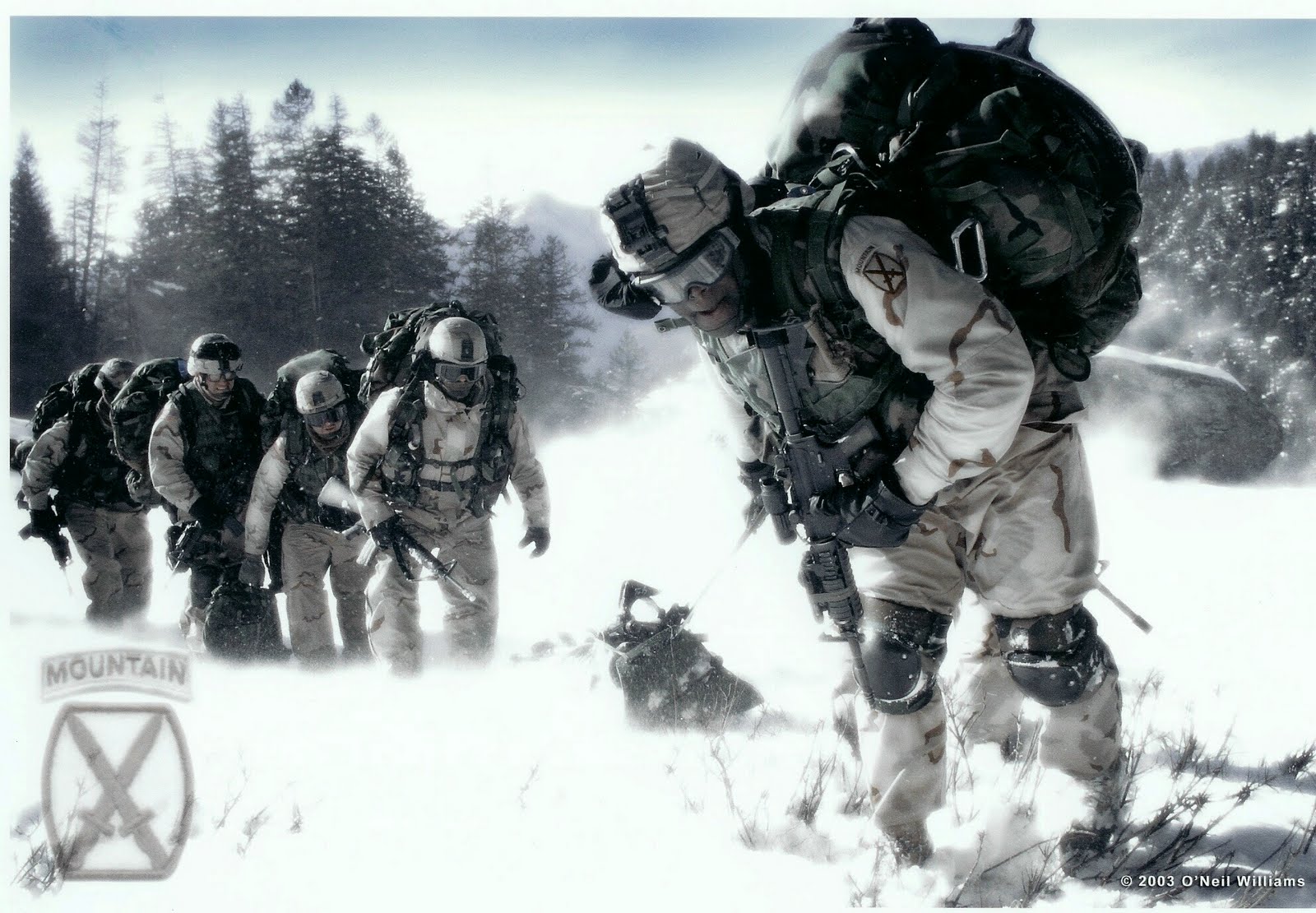
So their I was at 18,000 feet spinning out of control in the pitch black Canadian sky. About 10 seconds earlier I had been sweating my ass off in the back of a C130 cargo plane as it made it way towards our drop zone. I was sweating because I was dressed for the -75 degree F temperatures I expected to experience in the Canadian wilderness and the Air Force crew chiefs had the heat cranked up because their little feet were chilly!!! They were cold because the tail gate was wide open as my team was about to make a High Altitude Low Altitude (HALO) parachute jump onto a frozen Canadian lake in the province of Quebec.
My battalion, the 3rd Battalion 10th Special Forces Group had deployed from our home base of Fort Devens, Massachusetts to CFB Valcartier, Quebec, Canada to conduct cold weather training in the winter of 1994. We had started out doing downhill and cross country ski training, winter survival, long range movements and cold weather medical training. After 3 weeks the exercise was to culminate with a 10 day field problem in the harsh Canadian winter. So we had done our pre-mission training and conducted our 72 isolation exercise where we had gotten our mission statement from the battalion staff and developed our courses of action. Once we had identified the most viable course of action we hashed out the details and presented our plan of execution in breifback format to the Battalion Commander for his approval.
In brief my team was to infiltrate the operational area by HALO and move up a frozen river bed about 15 kilometers to our objective. Once in the objective area we were to conduct a demolition raid against an “enemy” radio tower and stop its transmissions. After successful silencing the broadcast we were to exfiltrate 200 kilometers by MOST (Mobile Over Snow Transportation) which is an Army acronym for snowmobile. Easy huh?
After our plan was approved, our gear was packed, and all rehearsals were complete, we conducted premission combat inspections (PMCI’s), ate and moved to the airfield to gear up for our infiltration. At the time I was a Staff Sergeant and the junior weapons sergeant on my detachment. My rucksack was packed with a 2 man tent, PRC-104 radio for High Frequency (FM) long range communications ,PRC-126 radio for inter-squad communications, extra batteries for each, 800 rounds of ammunition, 10 days of rations, night vision goggles, 5 quarts of water and in what ever room was left was my personal cold weather gear. My ruck weighed about 90 lbs and no space was wasted. In addition to the rucksack I also had my load bearing or ammunition vest containing all my survival gear, a complete IV administration kit, 4 quarts of water and another 400 rounds of ammunition. To top it off since I was the junior weapons sergeant and my senior weapons sergeant was acting as our second in command for this operation I was also carrying the SAW or squad automatic weapon.
The SAW was fielded by the Army to replace the automatic rifleman position at the squad level. It can fire the standard 5.56 mm NATO round either from links or from an M16 30 round magazine. Someone I love once called it a fifteen pound hunk of worthless metal. So now we were on the airfield gearing up for jump and I didn’t know how to rig the SAW for a HALO jump. Neither did anyone else, the SAW was new enough that it wasn’t something that was jumped routinely. One of the jumpmasters helped me mount my rucksack between my legs and then he decided to rig the SAW as if it were an M16 rifle. So he put it on my left side, barrel down, with the butt stock tied to the equipment loop on the left shoulder of my parachute harness with and the waist band of the harness over the weapon and under the carrying handle. Once rigged up we waddled onto the plane like a bunch of penguins on steroids and took our seats in reverse exit order.
At six minutes out from the drop zone the jump lights lit up bright red to warn us. As the plane continued to fly towards the jump off point we adjusted our gear and did last minute co ordinations with the pilot. All this was done in the complete darkness of the back of the plane and in silence. We had all donned our oxygen masks at the beginning of the flight and had been pre breathing 100% oxygen for the last 2 hours. At 3minutes out the tail gate opened allowing us to view the murky darkness that was punctuated by the few dim lights visible 20,000 feet below. At 2 min out the jumpmaster climbed out on the tailgate and hung almost his entire body out of the plane, exposing himself in an attempt to visually identify the drop zone that was some miles in the distance. He signaled us to stand up and move forward to the edge of the ramp. At one minute the jump lights turned green and my team was poised on the edge of the ramp in nervous anticipation. As we flew towards the release point the jumpmaster gave us the signal to standby and gave a few last minute corrections to the crew so that the plane would intersect the exact point on the ground he had calculated for our release. When that intersection occurred the jumpmaster stood up and pointed out the ramp, before his arm was even extended we were pushing each other out of the plane in a mad bailout into the darkness.
The object for any Military Free Fall Parachutist, skydiver, bomb, cat or anything dropped from a great height is to stay symmetrical. Symmetry equals stability. People jumping out of perfectly good aircraft need to maintain a good clean body position with their head up and each side of their body doing the same as the other side. The slightest conflict or unbalance can cause any numbers of problems, such as buffeting, tumbling or spinning. This brings me to the beginning. As I exited the aircraft I had a good stable exit and transitioned into normal freefall after about 3-5 seconds. Then things started going bad, the genius who had rigged my SAW had rigged it with 80 pound test and the weapon was too heavy for this. As soon as I got stable the tie down on my upper shoulder broke and the weapon canted straight out to my left. You guessed it; I was suddenly unsymmetrical and starting to go into a violent spin. I tried to counter by turning towards the opposite direction of spin as we are taught but all the gear I was wearing restricted my movement to the point where countering wasn’t very effective. I continued to gain speed and the whole time my mind was racing. I was worried that the SAW would fly off into space since the only thing holding it right now was my waist band, I was worried the blood vessels in my eyes would burst from the pressure exerted by the spinning on my extremities, and I was worried I wouldn’t be able to pull my ripcord (that was a big one). Since pulling high was almost as dangerous as pulling too low I decided to ignore the spin and firmly grasping my ripcord, I held on to it as my eyes were glued to my altimeter. When the needle approached 4000 feet I pulled as hard as I could and prayed I had packed the parachute with no malfunctions.
Due to the spin my parachute opened very stoutly, which is putting it mildly. I also had twists in the suspension lines all the way up to the bottom of the canopy. I started bicycling out of them and by the time they came out I checked my altimeter and saw I was at about 1500 feet. I frantically searched for the drop zone below, trying to orient myself for landing. I finally spotted the wind arrow on the ground which indicated the way the wind was blowing. Seeing that at least I was still upwind of the arrow I breathed a sigh of relief, being downwind was bad. I set up for my downwind, cross wind and final approaches much as an airplane does when it comes into land. At about 350 feet I was headed into the wind and started to prepare to land, I dropped my rucksack off my legs and released it to dangle on the fifteen foot lowering line that was hooked to my left side equipment attaching point. This caused a pendulum action as I neared the ground. The ideal way to land a square parachute canopy is to face into the wind and pull down on the brakes lines which collapse the back of the canopy just prior to hitting the ground. If executed correctly forward movement will cease and the parachute will start to drop at the precise moment the parachutist feet come into contact with the ground. At night it is a little more difficult, since it is almost impossible to judge distance and depth in the dark parachutists are advised to pull their brakes lines halfway down to slow forward movement and put their feet and knees together so they can execute a parachute landing fall which is basically a controlled collapse onto the ground. Parachutists are taught the five points of contact are feet, calves, knees, buttocks and back muscles. What they learn in reality is the most likely points of contact are feet, ass and head in that order.
Heading into the wind and putting my feet and knees together I was watching the wind arrow on the ground trying to judge my height above the drop zone. When I thought I was going to be about 15 feet above ground I was going to go to half brakes and prepare to land. Good plan but what I didn’t count on was the snow. You see the wind arrow was made up of red railroad flares and having been burning since about 10 minutes before we jumped they had melted their way through about 10 feet of snow and were actually below ground level. I found this out as I was preparing to land, suddenly and unexpectedly there was a violent encounter with the terra firma. I hit the ground so hard it felt like someone had reached in and grabbed my spleen slapped it around a little and put it back. The goggles that were covering my eyes literally disengaged from my face about 2 inches, just enough to gather up some snow and slam back into my eyes as the elastic band holding them on stretched and rebounded. So I lay on the ground for a minute doing a mental inventory of my body and trying to clear the snow pack from under my eyelids. Finally I got up after all body parts and pieces were accounted for, put my weapon into operation, gathered up my parachute and ruck and started double timing towards the linkup point. Man, I was hoping the rest of the mission went better than the first part other wise it was going to be a long two weeks.