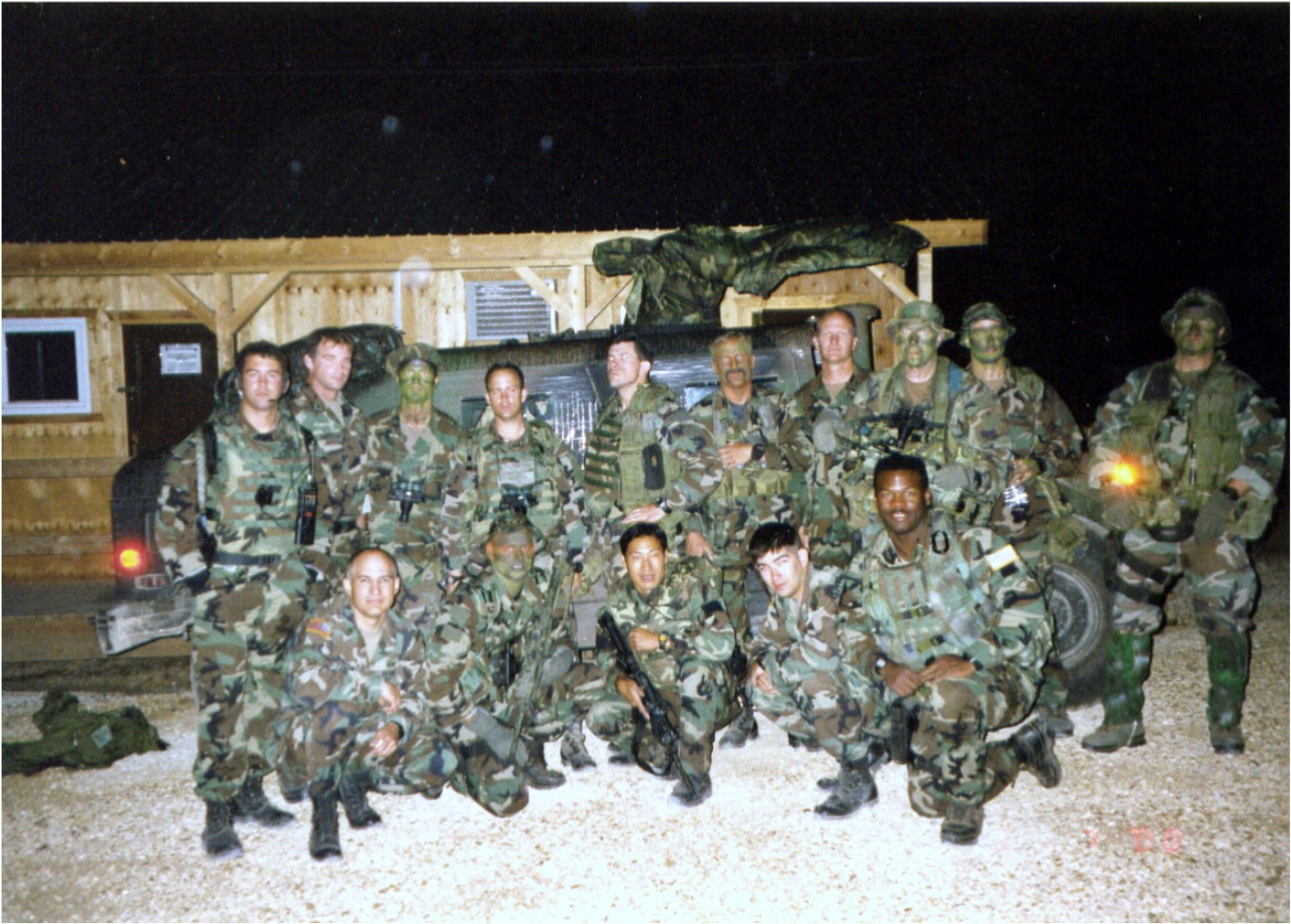
Friday, July 30, 2010

No Man's Land


We had established our patrol base in the Iraqi village of Klaw Kut. After dusk myself and my A team had moved out in our Land Rover Defenders accompanied by some Kurdish Peshmerga in a rusty Suburban. We had recently moved from the larger village of Taq Taq through the former Iraqi lines and into our current place of residence. Some of the ODA remained at the patrol base while we conducted a leader’s recon, attempting to pinpoint the Iraqi lines and identify a good observation post from which to call for fire and report back intelligence on the Iraqis.
The Peshmerga took the lead driving along the rutted dirt road by the light of the moon, utilizing no headlights or markers for fear of an Iraqi ambush. We drove with night vision goggles mounted to our helmets and I wondered how the Kurds could see at all without the aid of technology as the moon was half full at best and often covered with clouds. Great night for concealment, poor night for driving, we were spaced out in tactical convoy formation the Pershmerga followed by our two vehicles.
Eventually we left the road and started driving straight across the Iraqi countryside generally heading southeast through terrain littered with large rocks and short stubby grass. The terrain was gently rolling hills whose shadows hid many small villages that lay in ruins. These were the product of Saddam Hussein’s Kurdish eradication policy and had been abandoned for some time. Knowing this did not keep me from peering through and around every tumbled down wall with my night vision goggles as if they would grant me x-ray vision to see the ambush that I felt was lurking in every corner.
At the start of the war the Iraqi’s had pulled back from their original defensive line and consolidated just north of the oilfields surrounding Kirkuk. My unit the 10th Special Forces Group along with elements of 3rd Special Forces Group, A Marine Expeditionary Unit, the 173rd Airborne Brigade, and the Kurds had filled this gap and were pressing south trying to keep the Iraqis engaged in the north of the country so they could not reinforce Baghdad and cause trouble for the main Allied thrust which was coming from the south. Our main mission was to pinpoint where the Iraqi’s had their defensive perimeter so we could reengage them.
As we crept forward at approximately 15-20 kilometers per hour we were constantly stopping to dismount and check the terrain ahead for any signs of the enemy. Our dismounts would clear the area to our front and then we would move ahead, in a modified bounding overwatch technique.  This area we were driving through belonged to no one, it had become a buffer, a no man’s land between the autonomous Kurdish region of Iraq and the readjusted Iraqi lines. It was inhabited by wandering Iraqi units, Pershmerga, American Special Forces, and bandits. It was what I imagined the Wild West must have been like, no boundaries no definite good guy/bad guy; just a lot of guys with guns and everyone had an agenda.
Suddenly my vehicle came to a silent halt and my driver motioned that the Kurds up ahead had stopped their vehicle and dismounted. They were moving slowly forward in the Kurdish version of a patrol formation, what I might have called a gaggle, towards where the valley we had been following intersected with a small ridgeline. After we dismounted we could hear some faint noises ahead and see the barely present glow of what looked like tail lights about 200 meters ahead. We all trained our weapons on those glowing lights in anticipation of a night about to go badly.
Our Team Leader took a few of our guys and moved off in the darkness towards the Kurdish gaggle in an attempt to identify what lay ahead. After what seemed like forever the word was passed back “Peshmerga!! Bring the vehicles forward.” Believe it our not we had run across another vehicle full of Peshmerga that was roaming the battlefield and they had managed to run themselves axle deep into a small pond. After a security perimeter was established, as quietly as we could and using our night vision equipment we towed their vehicle out of the pond using the winch on the front of one of our Defenders.
These Pesh were so happy we had helped them out they decided to become our personal body guards and followed along behind our vehicles like baby ducks following their Mom. As we inched closer towards Kirkuk the skies overhead were being lit up by flashes of flares and chaff being dropped from U.S. fighter aircraft towards the Iraqi lines as the Iraqi anti-aircraft artillery shot red and green tracers into the sky in random patterns. We could hear the muffled thuds of explosions, and the budda-budda like sounds of the DSHK machine guns, however our immediate surroundings were so quiet you could hear a pin drop and it all seemed very surreal. The thought kept crossing my mind that I had seen the same sort of scene on the news during the first Gulf War but know here I was living it.
We continued to skirt the Iraqi positions with our little convoy stopping, watching, listening, and reconnoitering possible observation post positions. As the night wore on and turned into morning we headed back to the northeast meandering our way to our patrol base by another route. Arriving just as dawn was breaking, we enjoyed a breakfast of flat bread, chai, chicken-rice. We laid out the map and prepared our patrol order for the upcoming evening’s activities. Based on our recon we would be establishing an observation post along the edge of a fairly deep and wide ravine with a good view of the Iraqi positions. The ravine was about a mile wide and cut through the countryside like a mini Grand Canyon right up to the huge ridgeline the Iraqis had set up shop on. We conducted the patrol order, rehearsals and gear preparation, and then the majority of us took an afternoon siesta after our long night and day in no man’s land.

Saturday, July 17, 2010

Extracurricular Activities #1: Emergency Medical Technician

As many of you know and many do not I spend a lot of time doing "jobs" that aren't really jobs. My wife claims I am a workaholic and can't sit still, my kids say I have OCD. Bottom line is I try to keep myself busy because honestly ever since I retired from the military I get bored just sitting at home. I have several things I do on a regular basis and I thought I would write about each one of them.

When I was on a Special Forces ODA we did cross training on medical treatment procedures. This was out of necessity since there was twelve of us and we only had two medics. We often broke down into even smaller units so not every group got there own medic. However we still needed to manage any situation that may happen in training or combat, so our medics trained us. Special Forces medics are some of the most highly trained medical personnel in the military as far as trauma management and all around general medical practices. I trusted these men with my life, I even let one of them operate on my dog. That is how much I respected their skills. So long story short I spent a lot of time in the military training on medical issues even though I was not a medic. When I retired from the military I got this wild idea that I should get qualified as an Emergency Medical Technician both because it interested me and because I had this vague idea of applying to a fire department somewhere.

The fire department idea never happened but I did get qualified as an EMT-B. The course was ten weeks long, two nights a week, four hours a night. We started out with over thirty students and about 11 of us finished our national registry. Not that the training was all that hard but it took discipline to study around work etc... and as I discovered then and since outside of the military there is a lot of lazy floating around. Many of the "students" thought the instructor was being unreasonable when he/she asked them to produce results on a weekly basis. The class I took was fast paced, we went through two chapters of the text a night, followed by an hour of practical skills and every class ended with a must pass test on the material from the class before. The national registry exam consisted of a proctored written exam and a practical where you had to assess and treat a patient in three different scenarios either medical or trauma related. Reminded me of about every school I attended in the military, but like I said many couldn't and didn't make it through the training mostly due to lack of effort.

After graduating I used my skills sparsely for a few years, life took over and my idea to be an EMT went on the back burner. I did work part time at the local Minor League Baseball park for one season as an EMT which mostly consisted of me watching the game and putting ice packs on people who got hit with foul balls. Was a pretty sweet gig but it only lasted a few months. Eventually my certification was coming up for renewal and I discovered since I wasn't employed by any medical service ie.. a ambulance service, hospital, or fire department. I would have to attend a 24 hour EMT refresher if I chose to remain certified. After attending the refresher and getting re certified, I decided I better get on the stick and use my skills or give the idea up. I searched around the internet and found an ambulance service 15 miles from the town I live in that took volunteers, I applied and they accepted me.

The service I run with covers a rural area of over 150 square miles and services a population of a little over 6000. There are about 20-25 volunteers, we have 3-4 paramedics, most of the rest of us are EMT-B and we have a few volunteers that aren't certified, here is our website http://www.lmvas.org/. The service will send you to EMT-B class if you agree to volunteer for a year. The State of Iowa rates us as a Paramedic-minimal staffing service. That means we are a Paramedic level service but if one is not available we can leave the garage with an EMT-B as crew chief. If that EMT encounters a situation where advanced level skills are needed they can call for a mutual aid from the County Sheriff Paramedic or the paid service in the large town where I actually live. This doesn't happen too often as our Paramedics are some of the most dedicated volunteers I have ever seen and they volunteer hundreds of hours a month and go on dozens of calls all for volunteer wages and while holding down their own full time jobs. I and a few other EMT-B's are training currently to become future crew chiefs to re leave some of this workload however.

Since I live out of town and we are required to respond within seven minutes of a page I have to stay at the ambulance garage when I am on call. They have a little bunk room there with TV and internet access so it isn't too bad. My wife is awesome as usual and doesn't say one word about the 7-10 nights a month I sleep away from home. She is used to me being deployed anyway after 23 years of marriage the first 17 in the military.

Over 80% of the EMS services in Iowa are covered by volunteer services most of them rural. Iowa is also heavily geriatric so we get a lot of calls for older patients.  I actually attended a class this winter on GEMs (Geriatric Emergency Medicine) just because of this demographic. That is not the only type of call we get however. Since I have been on the service I have responded to unexpected home births, car accidents, serious trauma, hypothermia, motorcycle accidents, and a multitude of medical calls. Others on our service have responded to gunshots, suicides, and heart attacks. We pretty much run the gambit. I have learned a lot and I really enjoy the opportunity to use my medical training helping people. So next time you see a ambulance go by say a prayer for those inside and thank the volunteer who is in the back and driving the rig. They save lives for no or little pay so a thank you is always appreciated.Better yet hook up with a service and volunteer yourselves. If you're ever close to Highways 30 and 1 in Northeastern Iowa stop by and say hi.

Monday, July 12, 2010

4th of July 5K

 
Ran in the Alliant Energy 5K again this year as I have done every year for the last 10, unless I was deployed. Ran 4 minutes faster than last year but was still beaten by an 8 year old. I think he was from Krypton or someplace.
http://www.fifthseasonrace.com/results/images/results/96525th%205k%20overall.htm

Saturday, July 3, 2010

Recon Patrol


On my second deployment to Kosovo in 2000, I was the acting Team Sergeant of an ODA out of 1st Bn 10th SFG (A) in Boeblingen, Germany. I was “acting” Team Sergeant for the ODA due to the fact that I had just been made a promotable E7 or Sergeant First Class. Promotable meant I was on the list for promotion to Master Sergeant but it wouldn’t happen until my number came up. This was all new to me, I had never been a Team Sergeant before and I was taken off the Military Freefall ODA I had been on for the last two years and put on an ODA that had just lost a very good Team Sergeant to his own promotion. There was some initial suspicion among the other team members due to the fact that I was a “new” guy and also I was perceived as somewhat of a “HALO GOD” due to my long time spent on Military Freefall detachments. There is even professional jealousy among special operators but I had never felt any of it towards others. Eventually this suspicion went away and a few years later a few of these same guys asked to be on the Military Freefall ODA I was Team Sergeant of. It’s hard to live up to a legend though and I don’t think I ever did measure up to their previous Team Sergeant in their eyes. We were different people and they had been an extremely tight unit, but the mission got accomplished and that is all that mattered.
My second tour in Kosovo was very different from the first. The first time around we were all geared towards winning hearts and minds and stabilizing the country. We were staying out in the countryside and doing presence patrols trying to meet the people and showing the American Flag. This time, a year into U.S. operations in the region, we were deployed to conduct special reconnaissance missions against selected targets. This meant instead of trying to be seen we were trying to remain undiscovered. We ran all of our patrols out of a compound on the northern end of the main U.S. base Camp Bondsteel. Our compound was a base within a base, our headquarters building, isolation /planning area, barracks, and recreation area were all surrounded by a double thick wall of HESCO barriers that separated us from the “regular” Army guys. My team was attached to a company from 2nd Bn 10th SFG(A) who were running their own very different operations across the countryside. Also conducting reconnaissance with us was a platoon of Navy Seals, our two units would trade responsibilities during these missions. Part of one unit would conduct the actual recon while the rest of that unit and the other unit would team up and act as a quick reaction force in case there was any trouble. This QRF could also extract the recon team on short notice if needed. We spent our entire tour in this manner, flip flopping responsibilities. In between missions, as most Special Forces teams do, we conducted weapons and equipment maintenance and trained and trained some more.
A typical mission happened about half way through our tour. There was suspicion that a Kosavar Albanian terrorist group was conducting planning meetings for some future bad acts at a village located in a mountain valley in north eastern Kosovo. Our ODA was tasked to conduct surveillance on this village and report back to the Joint Special Operations Task Force (JSOTF) any pertinent intelligence we may gather. Once we got the initial briefing from JSOTF we initiated the mission planning cycle in our isolation bay. Once in “isolation” for a mission SF teams do not interact with anyone but their own team mates and are totally focused on the mission and the planning for it. The 72 hour planning cycle included conducting METT-T analysis, developing courses of action, choosing the most feasible one, developing the plan of action and contingency upon contingency. Finally rehearse, rehearse, rehearse. One of the rehearsals developed by our Engineer Sergeant involved crawling through a pitch black bomb shelter with full gear and night vision goggles on. This bomb shelter was also fiendishly booby trapped as only an SF demolition man knows how. We went through it one after the other until we could move through without blowing ourselves up. Then we went through as buddy teams and finally as a entire team. As we were to infiltrate by Blackhawk helicopter we went out to the airstrip and practiced loading and unloading the aircraft until we could do it with our eyes closed and in the dark. Finally we conducted our brief back to the JSOTF commander and were given the green light for the mission.
The night we were to infiltrate we packed and inspected all our mission essential equipment and personal gear. Stripper clips, time fuze and det cord were laying every where as we loaded bullets into our magazines and primed our claymores with 10 second delays. These Claymore anti-personnel mines were to be used at the tail end of one of our immediate action drills. This particular drill involved breaking contact using the “Australian Peel.” If heavy contact was made our lead man would empty his magazine and then peel back down our “ranger” file while the next man emptied his magazine and then did the same. So on and so on until we had broken contact with the enemy. Then the claymores would be emplaced to discourage any further pursuit by hostiles. Once we were geared up and ready to go we loaded into our vehicles for the ride to the airstrip.
Upon arrival we loaded in to the helicopter and listened to the whine of the blades as they changed pitch and we lifted off. Our flight route followed a well known supply route for U.S. Forces. It was our hope that with this and several false insertions along the route our target would be tricked into thinking our helicopter was just another mail run up to the main Kosovo Force (KFOR) headquarters. We conducted several false insertions until the crew chief told me over my headset that we were one minute out from the mountain meadow we had chosen as our infiltration landing zone. The Blackhawk came to a hover a few feet off the ground and the static electricity coming off the blades swirled likes shooting stars as we piled out of the bird and set up a hasty 360 degree defensive perimeter. As soon as they were satisfied all of my team had un-assed the bird the helicopter took off suddenly leaving us in silence. As we moved into the tree line we could hear it moving off in the distance conducting one more of our planned false insertions before they made their way back to base.  Once we were in the cover of the trees we set up another perimeter and remained absolutely quiet and alert. We stayed there for almost 20 minutes satisfying ourselves we had not been compromised and adjusting our eyes and ears to the sights and sounds of the battle field. From that point on conversation, if at all, would be in very low whispers and an elaborate system of hand and arms signals. We would move in single file through the woods and darkness spaced out enough to react to an ambush. Our point man would be first, our compass man second, and as the Patrol leader I would be third in line. The rest of the patrol members would be trailing out behind us.
Combat Patrols at night are an elaborate ballet of movement, security, and navigation. Patrol members needs to remain alert for ambush while at the same time navigating through unfamiliar terrain using a map and compass in pitch darkness. All the while they need to avoid the dreaded “break in contact” where part of the team gets spread out and loses track of the rest of the team’s location. As per our standard operating procedure we had infiltrated our objective area at least one terrain feature away from our objective. And since this part of Kosovo was mountainous that terrain feature was a huge ridgeline. We picked up our rucksacks and started silently moving on azimuth towards the objective. Our movement would consist of five kilometers of up a mountain down a mountain, along with the occasional stream crossing and navigational readjustment. As dawn approached we were within 500 meters of our planned patrol base and myself and two of my other team members conducted a leaders recon to determine the best position to set up shop.
Unfortunately the best area for cover, concealment and observation was the side of another huge ridge that faced the valley in which the village was located. This location gave us great line of sight for our optics and digital cameras; it also allowed us a good satellite communication shot for our SATCOM radio. It was defensible and gave us several good escape routes. Bade news was the pitch on the slope was so steep that you could not sit or stand straight without tying yourself off to a tree. We had thought of that contingency however and we were each carrying a section of one inch tubular webbing and a snap link that we could fashion into a safety harness. We quickly moved in before the sun was up and set up our spotting scopes and communication equipment. We camouflaged our positions with some hide material (camo nets) we had packed in our rucksacks. We stayed at 50% security during the whole patrol; while half the team rested the other half conducted observation and pulled security. Every morning before dawn and just before dusk we would conduct stand to and stand down where the entire team was on 100% alert.
We conducted surveillance for three days and nights, taking dozens of digital pictures and transmitting them via SATCOM radio back to the JSOTF. We took pictures of vehicles, license plates and individuals entering and exiting houses in the village. The JSOTF would compare this information to a data base to see if any of the individuals were known terrorists. We also transmitted situation reports or SITREPS twice daily on any suspicious movement or activity. We discovered a few large gatherings conducted at a particular house and we forwarded this information on, the most suspicious thing we discovered was that whenever a KFOR helicopter flew down the valley on its way somewhere the residents of the valley would sound their vehicle horns in a crude early warning system. You could hear these horns long before the sound of the helicopter rotor blades.
After three days of sleeping tied to a tree we packed up our gear and prepared to exfiltrate. Exfiltration was essentially the reverse of the infiltration, we moved silently towards our link up point under cover of darkness. Just as dawn was breaking we linked up with our QRF at a road intersection. We exchanged bonafides and they gave us a ride back to Camp Bondsteel in the back of our Hummvees. Once we debriefed the JSOTF Commander on our findings we all headed off for a shower and some much needed sleep. I myself was looking forward to grabbing a macchiato at the cappuccino bar and seeing if the mess hall had any new flavors of ice cream. It is the little things that make life tolerable.


Wednesday, June 23, 2010

Belated Father's Day Post..Sort of

I have tried to follow somewhat of a pattern here on my blog. One war story and followed by something more current. War Stories and random thoughts just like the tag line sez. However this week I have this overwhelming desire to get something off my chest. This past Father's Day got me thinking about being a Father and how .. wait for it... proud I am of my children. Those readers that do not desire to participate may want to leave now to spare themselves the bald face familial promotion that is to follow. Since my children do not know I am writing this all names have been changed to protect those that desire to remain anonymous.

My children tease me and call me a "sour marshmallow" mostly because I generally act grumpy and tough, the old NCO coming out in me I guess. However they also know they generally get what they want from me, that is the Father coming out in me. It is my twisted parenting philosophy that my children should work for what they get but it is my job to get them what I can. I developed this philosophy by watching the actions of my own Parents. When I was in High School I was a wrestler, not the WWE kind but the High School "Folkstyle/Collegiate" kind. Being from Iowa, the wrestling capital of the free world, there were also a lot of wrestlers that were much better than I was. I lived, breathed, and slept wrestling. I had pictures of Dan Gable, and the Banach brothers on my bedroom walls and I thought I too would be in the Olympics someday. This never happened but that didn't matter to my Dad. My parents managed to send me to wrestling camp every summer during High School. It wasn't easy but they made it happen, one year I had to wash the mats between sessions to help pay for the tuition but I was there. My junior year my Dad drove me over 300 miles one way so I could attend the camp of my choice, then he drove home and came back and got me 5 days later. My Dad knew I wasn't elite material but he also knew wrestling is what I wanted more than anything at that time. I never made it to the Olympics but the training of my will during those hard practices and the example of my Father made me the man and the father I am today. So even though my girls were never going to be All State saxophone players, when they asked to go to marching band camp two years in a row, they went. They detassled corn to help pay for it but they went, that is what Father's do just ask my Dad.

Ninja 11 is my oldest son, being the oldest he got to experience all the mistakes I made as a new parent. The temper tantrums, fits and pouting and that was just me. We did not always see eye to eye, him and I, especially when he skipped school his entire senior year and I never found out about it until it was too late. He was going to a DODDS school in Germany and their communication to parents was poor to say the least. So not being a stupid individual he cut his losses and earned his GED two months before he would have graduated anyway. He bummed around a few years and then decided to join the Army. My heart swelled the first time I saw a picture of him in uniform. N11 spent 3 years in the Army, a year of which he was deployed to Afghanistan. To look at my son most wouldn't think he was a combat vet, he almost always wears black and his hair is a bit too long for my tastes. He likes Japanese Anime and playing Massive Multiplayer Online games. He is a 3rd shift supervisor at the security company where he is employed, a position he worked his ass off for. He has nightmares sometimes and doesn't talk about his service that much. The Veteran's Administration is treating him for possible PTSD. Take a long look VFW,American Legion, and DAV these are the veterans that are coming home,you better do something for them. I am proud of Ninja 11.

Boochie is my oldest girl. She was diagnosed with a learning disability when she was three years old. She has a hard time processing things like the written word or math problems. This makes everything else that much harder. What makes it even worse her disability is not obvious, people that don't know her sometimes assume she is stupid or lazy when in her words "I don't get something." Since my wife is 100% Native American my children are also darker complected and tan easily. Some idiots think she can't speak English when she takes a while to read something. Despite all this she graduated from High School last year and is now attending Community College. Boochie is a social butterfly and the most honest person I know.  I cannot recall any time since she was old enough to know better that she has ever lied to me. She is dating a nice young man who treats her well. She teaches religious education classes at our church and helps serve at all the fish fries during Lent. She has a million friends and everyone always tells me how sweet she is. I hope she gets what she wants out of life. I am proud of Boochie.

The Mook is Boochie's younger sister, they are thirteen months apart and people often mistake them for twins. A lot of their friends call them"the twins" or "thing one" and "thing two." They are inseparable. The Mook graduated from High School this past spring. Mookie is the hardest working teenager I know.She will tackle any job with gusto and often makes up jobs for herself to do. She thinks it is fun to plant bushes,mow the lawn, or paint the bathroom. She is also dating a nice young man but she definitely wears the pants in the relationship. Mookie has been volunteering at a local non-profit since she was 15, in July she will receive a Iowa Governor's Award for Volunteerism from the big lug himself Gov. Culver. She makes me laugh everyday. I am proud of  The Mook.

Mr. Anderson is the youngest. He will be a High School sophomore next year. He was born with one kidney and a genetic disorder that makes certain physical actions painful for him. He never complains and he is my best buddy. We watch baseball,wrestling,football, and NASCAR together. I take him shooting and we both like Doctor Who. I guess his only flaw is he is a Minnesota Gophers fan. But at least he is consistent, he also likes the Vikings and the Twins. We went to a Twins game during the last season at the Metrodome and will also attend one this year at the Twins new stadium. What's a Cubs fan to do? Mr. Anderson has a lot of unrealized potential. I am proud of  Mr. Anderson.

I hope someday my kids are as proud of me as I am of them.

Sunday, June 13, 2010

Pizza is my constant

As any fan of the recently concluded TV Series LOST can tell you the character of Desmond Hume was the "constant" for the island. Desmond could move between the different alternate realities present in the series in a way that other characters could not. As I was making some homemade pizza for lunch today I realized that throughout the course of my life pizza has been my constant. Pizza is my favorite food but it has also been with me always in a way that other foods have not.

When I was growing up my parents would make homemade pizza using tomato sauce and Bisquick baking mix. Canned mushrooms and pepperonis where my favorite toppings but I liked just about anything on my pizza. As the working parents of six children, pizza was a meal that was easy to prepare,hot and cheap. I made my first pizza somewhere around the age of ten and I have never looked back. When I was in high school I got a job working at Happy Joe's pizza parlour. Happy Joe's is a local Midwestern chain whose signature combination of diced Canadian bacon and sauerkraut is my favorite of all time. At the time I worked there Happy Joe's had big stone ovens. We had to grab the pizzas using long handled paddles that sometimes weren't quite long enough. I still have scars on my forearms 30 years after the fact from trying to reach the pies in the back.

We made the pizza in front of a huge glass window that all the kids would press their noses against. The uniform of the day was a straw hat they called a "boater"and black and red pinstriped shirts. Happy Joe's had a 1890's theme which was kind of a pain but the pizza was and is still awesome. I worked at Happy Joe's for the entire time I was in high school, the summer prior to my enlistment in the Army I was given the absolute coolest job any teenager could have. I was the "dough guy" I came in every morning and unloaded the delivery truck, took inventory of the pizza"skins" that were left in the cooler and went down to the dough room in the basement of the building. For the next 3-4 hours I would jam out to tunes while rolling out and cutting all the new pizza crusts and then making 5-6 55 gallon drums of new dough that I would put in the cooler to rise for the next day. It was just the kind of work I have always enjoyed, give me a task and stand out of my way.

At my first duty station Fort Bragg I rented a room from some friends, this was my first official place. And even though it was just a room in someone else's house it had a kitchen and often we would cook pizza. Once again because it was cheap and it went well with beer. I still remember the mix we used, it was called Appian Way named after the ancient Roman highway. I guess that was supposed to make us think it was authentic Italian but since it came out of a box bought from the Winn Dixie I highly doubted it was authentic.

And so it went throughout my travels, every where I went I would look for a good pizza. Once I made it to Europe I discovered that what we call pizza in the United States is not exactly the way they make it on the continent. I ate pizza in Germany and Switzerland, the cheeses were outstanding but they tended to pile all the toppings in the center of the pizza in a small mound. In Kosovo the neighborhood we stayed in had a Serbian pizzeria right down the street. I bet my team provided over 50% of its income in the 5 months we lived there. I used to order a large ham pizza and eat the whole thing myself. In my defense a Serbian large is about an American medium and the ham was really good Italian prosciutto. In Greece I ate pizza topped with fried eggs and olives. Not my first choice but still pretty good. In Turkey I had pizza at a restaurant on the coast of the Mediterranean, drinking EFES pilsner and watching the fishing boats bob in the water.

Eventually I made it to the mecca of pizza, Italy itself. I ate pizza topped with goat cheese and Roma tomatoes in the south of the country. Around Brindisi the toppings tended to be seafood related and tuna was a topping as well as shrimp. I ate thick crust pizza in Naples in the style of that city.Much like our own country Italy has regional variations on pizza. One point of order however, if you order pepperoni pizza in Italy you get pizza topped with small hot peppers not slices of meat. If you want what we call pepperoni you need to order salami. Learned that one the hard way. I think the best pizza I ate in Italy was sitting outside a small cafe' in St. Mark's square in Venice. I was drinking cappuccino, the pizza was cheese, the atmosphere was something I will never forget. I ate that pizza watching the sun go down over the canals wondering how a guy from Iowa had made it that far.

Even though I haven't left the Midwest lately I still enjoy pizza. The quick pizza you throw together using Chef Boyardee to the pizza I make using my pizza stone and gourmet ingredients. Pizza will always be my favorite and my constant.

Monday, June 7, 2010

Ελληνικά (Elefsina)

Every time I hear or see the recent troubles in Greece on the news it reminds me of the Joint Combined Exchange Training (JCET) my team ODA 014 conducted in 1998. I had just arrived in Germany for a three year tour about 3 months prior when my team was tasked to conduct the Military Freefall training with the Greek ETA commandos. The ETA are something akin to our Navy Seals and the training would be conducted at the Greek Airborne School in Elefsina just outside of Athens.


I know you’re not supposed to have favorites much like parents and children, but ODA 014, out of all the ODA’s I was on is my clear favorite. I was the Senior Weapons Sergeant then the Intelligence Sergeant on this ODA for 2 years. We once added up the combined operational team time of all the members and it came up to over 100 years. The average amongst the enlisted guys was 10 years on an operational detachment. The width and depth of special operations knowledge on this team was second to none. Ranger Tabs, Military Freefall Jumpmaster Badges, and a variety of special operations skills abounded on this team. This was the best group of guys I ever served with, we were just really tight.

So in September we deployed down to Elefsina from Stuttgart on a C130 aircraft landing at the Athens International Airport. The Greek cadre met us and we off loaded our equipment onto a flat bed truck and an old school bus. After cramming into the bus they drove us through downtown Athens on our way to the school. Never having been to Greece before or since, I was really drinking in the scenery. I could see the Acropolis from the bus window and I hoped I might get to go see it ( I did). The traffic pattern in downtown Athens was pretty typical for a Mediterranean country. The general rule was he with the biggest vehicle and the loudest horn had the right of way. Most of the traffic lights were treated as mere suggestions as cars would line up 4 abreast in two lanes at intersections and little motorbikes would weave in and out of the larger vehicles with complete disregard for any rules of the road. I saw the same scenario played out in Italy and Turkey amongst other places.

When we arrived at the Airborne School we were billeted in an open bay barracks right behind the school Charge of Quarters office. Every morning as we left for training we would have to walk by the paratroop students standing at stiff attention in morning formation. Often they were being chewed out by the Greek Airborne Instructors in their blue t-shirts and black ball caps. I was glad I was through with that nonsense since I had graduated Airborne School in 1983. As we got off the bus our translator and liaison Alex Smiaris greeted us. Alex held dual citizenship, both Greek and Canadian. He had been born in Greece but his family immigrated to Toronto, Canada when he was young. When he got old enough Alex decided to join the Greek army to see the country of his birth and he just stayed. When I met him Alex was a warrant officer with over 15 years service. Alex became a good friend to all of us. I last saw him in Kosovo 2003. His ETA detachment was close to our sector and we did some combined training while there in Kosovo. Alex said he was going to retire upon his return to Greece after his Kosovo rotation. He told me he was going to be a deep sea boat captain and take tourists on fishing trips. I lost touch with him after Kosovo but I hope everything turned out as he planned and I know if I ever make it back to Greece I have a place to stay.

Like most “combined” training we did with our allies this trip turned into the Americans instructing and our allies learning. The combined parts came after training when we all took trips into Athens for a little stress relief. Everyday we would send a drop zone party to set the drop zone up for operations while the rest of us piled into the old school bus for a ride to the airstrip where we rigged up and got into the C130 for what was usually a hot, sweaty day filled with jumping, bus rides, and practical jokes. Once we got to know them the ETA soldiers proved to be hilarious. One day, after training, a couple of the ETA guys went and bought a few of us some T-shirts at a souvenir stand. They were olive drab with a caricature of an ETA commando slitting an enemy’s throat. On the top it had a Greek phrase and on the bottom it said “ATOM SQUAD.” They were so corny; we started to wear them under our fatigue jackets as a joke. That is until Alex told us the Greek phrase was “The only good Turk is a dead Turk” and that the soldier being killed had a Turkish star on his helmet. In the interest of NATO cooperation our Team Leader told us we had to quit wearing the shirts. I still have mine though.

The training was pretty standard and I completed the course of instruction many time during my years on a Military Free Fall team. Each MFF team in Special Forces is required to certify as “level one” every quarter. Being certified as level one meant you could deploy and infiltrate by HALO anywhere in the world in peacetime or combat. To be level one a team had to complete, at a minimum, 3 jumps during the hours of darkness wearing combat equipment (rucksack and weapon) and oxygen. Generally teams conducted the training in a stair step fashion starting out with day time “Hollywood” jumps without equipment and progressing until the training would culminate with the three required jumps. This is the pattern we followed on this deployment with the exception we also instructed our counter parts in the finer points of Military Freefall operations.

Since I had just recently come from being an instructor at the Military Freefall School our Team Sergeant assigned me all the problem children among the Greeks. I had to do corrective training on all the “non flyers” those with a bad or non existent body positions in freefall. Helping these guys out was fun and it also gained me some friends as they were very appreciative whenever I could help one of the soldiers correct a problem he experienced. We jumped on two primary dropzones, one was about an hour drive from the school. It was in the middle of nowhere and was literally a farm field. I almost hyper-extended my knee on one night jump as I landed and one of my feet slid out from under me as I made contact with a freakin watermelon. This drop zone was also plowed in an attempt to make it softer but all that really happened was the hard clay soil was pushed into big clumps that stuck out at all sort of crazy ankle turning angles. The Greeks also used burning tires as wind indicators and the smoke would waft none to sweetly downwind of the DZ party. The end result was there was quite a traffic jam on final approach as all the experienced jumpers tried to maneuver their canopies to land upwind of the vehicle on the dirt road that went through the middle of the DZ.

The other DZ was better. We didn’t get to use it much because it was the primary school DZ and they used it daily. However we did get to jump on it about ½ a dozen times. It was flat and well cleared of obstacles it was also about 1500 meters from the ocean. The Army Military Freefall Operations manual says you must wear floatation devices if jumping within 1000 meters of water, however since we had none and the actual DZ was over 1000 meters from the sea we kind of fudged that little requirement. Being HALO though sometime our release point was pushing the envelope a little; typically we would came in over the ocean on our jump run not hitting the beach until about 30 seconds out. It was a pretty cool sight looking out the tailgate and seeing the deep blue waters of the Mediterranean from 12500 feet.

One of the highlights of the trip was one of our final jumps. It was to be one of the level one certification jumps and it also was to be one the first jumps on to this particular location if not the first jump since World War II. In 1941 during Operation Mercury German Fallschirmjager (Parachutists) had jumped onto Crete in the largest German Airborne operation of the war. Crete became known as the Fallschirmjager graveyard due to the intense partisan activity that resulted in the death of over 400 German Soldiers. My team along with the ETA was going to jump onto the airfield at the Souda Bay, Crete NATO Naval base. We took off under the cover of darkness and as an added bonus we conducted in flight rigging.

In flight rigging is used for longer flights, this is where paratroopers actually rig up their parachutes and combat gear during the flight and don them when they get closer to their objective. Although oxygen was not required due to the altitude we would be jumping we were also training on oxygen console operations during this flight and would be conducting pre breathing activities. About 2 hours out myself and the other jumpmasters starting helping all the jumpers rig up and hook up to the oxygen console. After conducting Jumpmaster Personnel Inspections on all the others we did the same to each other and hooked up to the console. At about 20 minutes out the red jump lights came on and our primary jumpmaster started looking out the windows trying to orient himself. At 10 minutes out the lights turned green and would remain green until we exited or a problem developed. At 6 minutes out he had the first stick of jumpers stand up. Due to the number of jumpers we would be exiting in three passes with my team being last. At three minutes out the squeal of the hydraulics was heard as the tailgate game down and our jumpmaster walked out to the edge of the ramp to identify his release point. While he did this all the jumpers checked equipment and pins on their reserves. One minute out the jumpmaster gave the signal to move to the hinge of the ramp, this is also when all jumpers disconnected from the oxygen console relying purely on the Twin 53 oxygen canisters they had attached to their harnesses. At 30 seconds the thumbs up was given and all the jumpers moved forward and the guys in front hung ten on the edge of the ramp. As the plane intersected with the release point the Jumpmaster pointed out into the blackness and just like that the jumpers disappeared into the night. Once the last jumper had cleared the tailgate, the plane made a hard left turn to line itself up for the next pass.

The tailgate remained down as we made another ten minute racetrack and released another group of Greek commandos. Then it was our turn, as we went through the same commands I had seen thousands of times, I could feel myself reaching that high state of alertness I always attained prior to a jump. The moon was full out the back of the ramp and it looked like I could reach out and touch it, it was so huge. On the standby command we crowded the ramp, I was trying to take special care of my rucksack attaching points as I was wearing a front mounted ruck and didn’t want anyone to inadvertently release one of the straps prior to exit. On the go command, we bum rushed into the darkness and I could feel the old familiar sensation of “riding the hill” as my body actually slowed from the forward throw of the aircraft to terminal velocity. Once I was flat and stable I checked altimeter and saw I had plenty of time before pull altitude, I identified the glow of some green chemlights we used to mark each other in free fall and under canopy. We attached green to the back of our helmets and red ones to our chest straps. The idea being, see red “your dead”, meaning you better turn right or expect to be entangled with another jumper. I put my body in to a track position and increased speed as I flew over to my fellow teammate. When I got close to him I flared and saw it was Frank one of our Engineer Sergeants. Frank was one of our least experienced jumpers so I decided to mess with him a little. I had stashed an activated chemlight in my mouth prior to exiting the aircraft; I flew around in front of Frank and grabbed his forearms to form a “two way.” Once he was looking at me I smiled and I could see his eyes get wide as the green chemlight glow came pouring out of my mouth. I must have looked like a camouflaged Jack O’ Lantern. I checked altimeter again and saw we were about 7000 feet. I tracked away from Frank a safe distance, cleared my airspace then pulled my ripcord at the pull altitude of 3500 feet. The canopy ride was uneventful as we all lined up in our downwind, crosswind, and final legs for landing. Our team was so experienced and well trained we had landed in a tactical perimeter about 30 meters in diameter. We put our weapons into operation and maintained 50% security as we gathered up our parachutes and equipment. Once we were all ready to move out our Team Sergeant called an end to the tactical scenario and we all gathered on the edge of the airfield as the C130 landed to take us back to the barracks.

The day before we were supposed to depart the Greeks threw us a big old soirée, complete with goat meat and ouzo. Needless to say being Greek there was lots of ouzo drinking and man dancing. The best part of the evening is when we convinced our hosts to play a trick on our Team Leader. Every Special Forces officer is ingrained with the notion that they must get along with their “counterparts” and not offend them. This goes all the way back to Vietnam and the work SF did with the Montangards. So we had the Greeks bring the roasted head of the goat complete with eyeballs on a decorated platter and present it to our Team Leader as a delicacy. The funny thing was they were just going to throw the damn thing out. We had him convinced if he didn’t eat the eyeballs he would offend our hosts and the rapport we had built with the Greeks would go up in smoke. After we finally convinced him of our sincerity with a little help from Alex, he finally bit into an eyeball. No one could hold back their laughter anymore and we all roared and toasted his manliness with another shot of ouzo. The next morning with big heads and furry tongues we said good bye to our hosts and boarded the plane back to Germany. Another successful deployment complete.

Sunday, May 30, 2010

Memorial Day: Me and Jerry

Memorial Day is a day when we remember those who gave service to our country whose time on earth is through. For some it has become a day for BBQ and beer drinking. For those that have loved one's that have served however it will always be a day of remembrance. The first veteran I think of on Memorial Day is my Uncle Jerry. Jerry spent 28 years in the Navy, Active Duty and Reserves. He served during the Vietnam Era and beyond retiring as a Senior Chief Petty Officer in 1992.

Jerry is my Dad's brother and he and my Aunt Carolyn always treated my children and my wife as an important part of their family. On Christmas no matter where I was you could always count on the fact that Jerry and Carolyn would have a present for my children under our the tree. Jerry always liked to tease my wife and she thought he was a very good man. She was very sad when he passed.

As for myself Jerry was always extremely interested in my military career and how it was progressing. He would quiz me on the times when I came home on leave on what I had done and what I was going to do. and when I was promoted to SFC (E7) he was almost happier than I was. Being a Navy man making E7 for Jerry was a sign that you had made it. Navy E7's (Chief Petty Officers) cross the line from junior to senior enlisted. Navy E7's enjoy different uniforms and perks on board ship that the lower enlisted do not. I remember the time I got Jerry laughing when I told him how my Special Forces ODA was doing some Military Free fall training with Seal Team 10 at the Naval Air Station in Rota, Spain. During this trip it was quite comical to watch my friend Terry who was an E6 at the time try to sit in the Chief's area in the Dining facility or try to get a room in the Senior Enlisted Quarters. Terry tried but the Navy would have none of that. 

Jerry retired from the Navy in 1992 and he requested that I be at his retirement ceremony and present him with his flag. It was an honor I will never forget. When I retired myself in 2004, Jerry made the trip to witness my retirement just as I had witnessed his 12 years before. It was sitting in my garage after the ceremony when Jerry joked with me "now you will have to get a real job!" I indignantly replied that in my opinion I had been doing a real job for the last 22 years. He just laughed and said " You'll see."
In the military you can get an instant history of a man just by looking at his bearing, the badges on his chest or the unit patch on his shoulder. You know where in the hierarchy of things he is just by looking at the rank on his sleeve or collar. Civilian life is not like that and sometimes figuring out where you stand can be confusing. That is what I believe my uncle was talking about. Jerry you were right and I now know exactly what you meant.

Tomorrow when I go to the annual Memorial Day Ceremony, I will be thinking of you Jerry..Blue Skies always and see you on the high ground

https://www.cedarmemorial.com/obituary/1760/jerome-f--mcelmeel-cedar-rapids-ia/

Saturday, May 22, 2010

Kirkuk


 The radio transmission we received told us not to engage any target west of the base of the Kani Domlan ridgeline. I asked for authentication due to the fact we had been pounding this ridgeline and the Iraqi troops on it for a few weeks with airstrikes. The order was authenticated and myself and my commo sergeant looked at each other and shrugged our shoulders. We made a transmission back to our patrol base in Klaw Kut where the rest of our team was located seeking further direction. Our Team Leader informed us that the Kurds had broken through to the city of Kirkuk and that he and the rest of the ODA would link up with us at a small village that was situated on a road intersection just north of our position. It would take them a few hours to arrive so we leisurely packed up our gear and threw it in our vehicles. We headed north until we stopped at the agreed upon meeting point and discovered it was already swarming with Kurdish Peshmerga. We dismounted our vehicles and greeted our allies with some small talk and those that smoked enjoyed a butt.
While we were waiting our medic conducted an impromptu sick call for the Pesh, one young fighter hobbled up with a bullet wound in his lower leg which our medic quickly treated. From the facial expressions and gestures, I got the impression the other Kurdish fighters felt it was self inflicted. As I lounged on the bumper of our vehicle I watched the continuous and comical stream of Kurdish vehicles pour by as they headed south towards Kirkuk. The Peshmerga had commandeered anything with wheels in an effort to take back what they considered their ancestral home. A home that had been stolen from them by Saddam Hussein, and oh by the way there also just happened to be some very large oil fields located near by. Pesh were packed into the beds of the usual Middle Eastern vehicle, the white Toyota pick up, but they were also jammed into school busses, taxi cabs, and passenger cars. I even saw a dump truck with about twenty Peshmerga hanging out the back. All of theses were flying down the road hell bent for leather with scarves flapping in the breeze and rifles hoisted in the air.
I got out of the truck when I saw some Humvees headed towards us, at first I thought it might be another SF team although none were operating in our sector and none where driving such obviously marked military vehicles.  In fact it was a unit from the 173rd Airborne Brigade who had seen us sitting by the side of the road and stopped for a quick intelligence update. I laid my map out on the hood of this Major’s vehicle and pointed out to him the lay of the land and the targets we had been engaging. I estimated the Iraqi strength and probably direction of flight. He asked me a few more questions and got in his vehicle and their little convoy moved on down the road. This small encounter put in context why I had joined Special Forces. Here I was a Master Sergeant deep in enemy territory with my small team of kick ass troopers and our indigenous allies. I was wearing my University of Iowa baseball cap and hadn’t shaved in about a month. My team had more ammunition and fire power on us than a platoon of infantry. We went where we wanted and when we wanted within the scope of our orders.
This Major had his Kevlar on, chin strap tight, and was all dress right dress. It was obvious he didn’t like talking to a lowly E8. But the point was he needed the information we had and it was good to kick a little dirt on his regular Army boots so to speak. After they left my Team Leader showed up and we all joined the parade of vehicles going south. As we headed down the highway we started to climb up over the ridgeline and as we topped it I saw the damage we had inflicted. The pillboxes we had been directing our airstrikes onto where actually very large bunkers that looked like they led to tunnels farther underground. They were scarred with shrapnel and blackened by smoke. Time and the very real likely hood of booby traps kept us from investigating further. After we crossed over the Kani Domlan we could see the oil fields and the city of Kirkuk spread out before us. We also saw what appeared to be some kind of armored vehicle approaching us at a high rate of speed. It looked like nothing we had ever seen before but we were taking no chances. We got our vehicles off the road and prepared a vehicular ambush using our AT-4’s and Squad Automatic Weapon.  As it got closer however we came to the strange realization that this was a Toyota pickup truck so loaded with stacks of what appeared to be conduit and aluminum tube that from a great distance it looked like it was a Multiple Launched Rocket System. We packed up the ambush and waved as out little Kurdish friend drove by with his loot.
It was shortly after that we entered the chaos that was Kirkuk, the Kurds were vandalizing and stealing everything they could get their hands on in revenge. It was obvious they intended on pillaging the city. As there were only a few U.S. troops on scene in those first few days, there wasn’t much we could do about the whole scenario. I saw one Peshmerga driving a forklift up the highway out of town. I am not sure what he intended on doing with it, but it was his by god and he was driving it home. I also saw a full sized and operational fire truck heading back north. A few weeks later I saw this same fire truck abandoned on a mountain road with no wheels or battery. It must have run out of fuel and they stripped what ever was valuable.
We navigated to a link up point to meet our company commander and the rest of the company. The linkup point was at a large, gated house that reportedly once belonged to “Chemical” Ali the cousin of Saddam. “Chemical” Ali was like the Iraqi Kilroy, that dude was everywhere. Our company had experienced a short but intense firefight prior to our arrival but had secured the house. We linked up and were given some security positions to man on the flat roof of the building. From our vantage point I could see the entire city which mostly seemed to be on fire. I could also hear automatic weapons fire and explosions. Some were in the distance but some were quite close.
Once we got organized I reported to the Company SGM for a debrief and some further instructions. I will be quite candid here, I had no respect for our Company SGM the man was a Douchebag. When I reported to him it was the first time he had seen me in weeks he told me to have my guys shave and take the Kurdish scarves we were all wearing off. No “Hey Mike how’s it going?” or “You guys have been doing an outstanding job!” Just instructions that I had to take back to my guys and enforce that made me look like the same douche he was. Oh well, one thing about civilian life I don’t have to ever talk to that guy again. We stayed in this villa for a few days and then were told to find somewhere to set up a safe house to run operations out of similar to what we had done in Kosovo.
We ended up renting a gorgeous house on the South West corner of the city; it was all marble tile and stone walls with a large stone fence around the yard. The previous owner had obviously fled as no furniture or utilities of any kind were present, we weren’t even sure if the guy we rented it from had authority to do so. We organized the upstairs as an operations/communications room and started running patrols out of the house on a rotating basis. These patrols turned up some interesting things. One day we discovered an Iraqi Mobile Multiple Launch Rocket System stalled and on fire in the middle of the street another day we had to diffuse a small riot between rival Kurdish groups. The PDK did not take kindly to the PKK taking over one of the buildings they had claimed. Tribal loyalties run deep in the Middle East and these rivalries are pretty intense. Another day we acted as a PSD (Personal Security Detachment) for Jalal Talibani . He was a Kurdish leader that would eventually rise to the highest levels of the new Iraqi government.
An informant directed us to an Iraqi vehicle depot that had obviously been looted, but still provided some valuable intelligence. On the way back we cleared what appeared to be an Iraqi barracks and discovered some suspected chemical weapons we turned over to a U.S. Chemical unit. Just for the record, Weapons of Mass destruction where found in Iraq, because we found some. Our time in Kirkuk though was like a finger in a dike, there was only so much that a small contingent of Special Operators could do in a city that size. Every night we heard gunfire celebratory and otherwise. The Kurds where fighting a turf war with the Turkmen, and each other over control of Kirkuk. We saw tracers arching across the sky on a daily basis from the roof of our house. We also heard and felt some huge explosions that rattled our neighborhood as car bombs and IED’s became more prevalent. The smoke plumes would linger for hours from these explosions. After initially melting away the Iraqi resistance was starting to flex the muscle it would show in the bloody months of 2003-2006 prior to the “surge.” My time in Kirkuk is what makes me uncomfortable around any fireworks and sudden bangs to this day. Eventually conventional units like the 173rd moved in to take over responsibility for security in the city. My team and the rest of our battalion moved back north in to Kurdistan to refit and await further instructions. As we left the city once again headed north I didn’t realize that that would be the farthest south I would ever get during my time in Iraq.

Sunday, May 16, 2010

Fat,Slow, Distance

There is a training term in running circles. The term is long,slow,distance and it is what runners do as they prepare for a variety of endurance events usually over 20 kilometers. Due to being closer to 50 years old than 30 I have my own term. It stems from the fact that every year I seem to gain or lose a pound or two but mostly gain. I also find my pace per mile creeping up second by second year by year. When I was a younger man I used to be quite a speedster. I was usually one of the fastest in the company and my personal record for a two mile run was 10:32. At one time I could keep that pace for miles. Now I still enjoy running but I jokingly call what I do fat,slow,distance. I am a fan of John Bingham of "Penguin Chronicles" fame http://www.waddle-on.com/. John's believes everyone can benefit from running if they have the courage to start. So I will continue to run as long as I can move on down the road.


One of the races I ran this month was the Mall to Mall prediction race. This race is an 8.8 mile race between Lindale mall and Westdale mall here in Cedar Rapids. The cool thing about it is that it is a prediction race, you don't have to be the fastest to win you just have to be the best guesser. You are not allowed to wear a watch or ipod or anything that could help you keep a pace artificially. Since the course was an open course meaning no traffic would be stopped I was pretty conservative in my prediction. We started off at 0800 on the morning of the race on a nice spring day. The first part of the run took us through a cemetery for about a mile until we came out onto the main drag in Cedar Rapids, First Avenue. The course was flat and somewhat down hill for the first half. We continued down First Avenue eventually crossing over it and turning right on Third Avenue. The course took us through what I jokingly call the "ghetto." Compared to larger cities this area is nothing but in our city it is truly the ghetto. If there is a shooting in town you can bet it will be somewhere in this area. Most people blame it on the influx of welfare recipients from Chicago looking for a free Iowa handout. I am not sure I agree but I do know that on this particular day everything was quiet I guess all the criminals were still in bed. Once we crossed the river we started heading back up hill, the course took us on a detour through the Cedar Rapids Kernals ball park. The Kernals are the Class "A" affiliate of the Anaheim Angels and we got to run a lap around the warning track before exiting the stadium. Once we left the stadium we turned on to Wilson Avenue at this point I knew how far we had left because this was near my house and I often did training runs on this street. I had been holding a pretty steady pace this whole time but knowing where I was at I picked it up a little and started passing people as we went up the last major hill. We crossed over Edgewood Road and into the parking lot of Westdale Mall. As I crossed the finish line my time was 1 hour 19 minutes and 36 seconds this worked out to 9:02 minutes a mile. I had seriously underestimated my own speed and had run the race over 19 minutes faster than my predicted time. Oh well, the bananas and bagels at the finish still tasted good.


The next race for this month was the Rockford, IL. 1/2 Marathon (13.1 miles). I picked the location due to the fact my daughter's boyfriend lives in Rockford and I was looking for a race within 4 hours of home. I was only doing the 1/2 Marathon on this day because my knee had been acting up and I hadn't had the time to train for the full. On the day of the race I woke up at 0445 got dressed and grabbed the 0530 shuttle from the hotel to check in and get ready for the 0700 start of the race. Before the race I tied and retied my shoes, fiddled with my walkman, and stood in line at the Porto Potties. Finally it was race time,the sky was gray,overcast and the temperature was about 54 degrees. This was actually good running weather, and I was hoping to finish the race in 2 hours or better. The airhorn sounded as all 1200 runners started the shuffle to the start line that is normal for these large races. I finally made it to the official start about 45 seconds after the actual clock had started. No worries though since we all had individual chip timers on our shoes to keep an accurate time as we crossed electronic sensors at various points along the course. The biggest problem I have when racing is running my own race, I tend to let the spirit and adrenaline of the event trick me into starting to fast. The ideal race is one with a negative split which means you run the second half faster than the first,unfortunately this race was no different than any other and I found myself starting too fast. I finished the first mile in around 8 minutes and I knew I better slow down so I wouldn't slow down even more at the end. I was right on track and cruising along for the first 3.5 miles before we hit the first hill. This hill went from 3.5 miles to about 5 and was a long continuous grade. I concentrated on keeping a 9 minute mile pace and trying to ignore people I passed or even harder the ones that passed me. At mile 5 we went back down hill and then back up again before we entered a park and did a loop around a small pond. As we exited the park we hit mile 7 and I looked at my watch and saw I was at 58 minutes. I was on pace for a sub 2 hour race. The second half of the race was mostly flat or down hill. I really concentrated on my pace but about mile 9 I started having some issues with my knee and my left hip. The hip problem stemmed from what I guessed was an uneven gait as I was favoring my left knee somewhat. I also suspected the problems were because I did most of my training runs on a gravel road or on trails and this entire race was on pavement. The pounding on this hard surface was slowly wearing on my legs. At mile 12 I was at 1 hour 48 minutes. I had 12 minutes to run the last 1.1 miles. I kept moving forward and as we made the last turn I could see the large banner marking the finish line. I looked at my watch and poured it on for the last 200 meters. I crossed the finish line at 1 hour 59 minutes and 1 second, 59 seconds under my goal and a 9:06 per mile pace. I liked this race, there was plenty of water stops.One every 1.5 miles and 2 aid stations along the half marathon route. There was also plenty of encouragement along the route as it was all in town allowing for many spectators. I will probably do it again,maybe doing the full marathon next year. Next on the agenda is the Five Seasons 4th of July 5K.

Sunday, May 9, 2010

Sinai

If you set the way back machine to the spring and summer of 1983 you would find me on the southern tip of the Sinai Peninsula conducting operations as part of the Multi-National Force and Observers (MFO). I was a PFC and the assistant gunner for an 81mm mortar squad. Specifically, 2nd squad (base gun), Weapons Platoon, B Company, 1st Battalion, 325th Airborne Infantry Regiment, 82nd Airborne Division. Unlike the other regiments in the 82nd, which are designated as Parachute Infantry Regiments, the 325 is designated as Airborne Infantry since our regiment actually landed in gliders during World War II. After the war, gliders were phased out and the 325th was made regular parachute infantry. The designation stuck however, such are the vagaries of military heraldry.


The MFO consisted of units from many nations as the name suggests and still operates in the peninsula to this day. It was formed as a result of the 1979 Israel-Egypt Peace Treaty and was tasked with patrolling the no mans land along the borders of Israel and Egypt to make sure both countries were conforming within the stipulations of the treaty. The US Battalion occupies South Camp just north of the city of Sharm El Sheik and fans out small squad size elements to check points and observations posts within its sector. At the time of my deployment we were only the second United States unit to conduct this mission as we were to relieve a battalion from the 101st Airborne Division.

This was my very first overseas deployment and also my first deployment to a “hazardous duty” area. I didn’t know quite what to expect as we boarded the chartered Arrow Airways flight from Fort Bragg, NC straight to Sharm El Sheik, by way of Gander Newfoundland. It was very strange to me as we sat in our seats with our high and tight haircuts, M16 rifles and “chocolate chip” desert uniforms that there were stewardesses’ offering us sodas and peanuts for the flight. As would become my habit during my career I fell asleep as the plane took off only to awaken when we stopped in Gander for refueling. I wandered around the dark and tiny terminal with the other bored and hungry paratroopers gawking at the Canadian souvenirs in the closed gift shops and wondering how much longer we had to fly. Eventually we reboarded the plane where we were served a standard in-flight meal of rubber chicken, mushy green beans, and warm soda. I fell back asleep and was awakened by the whine of the landing gear as it extended itself for landing at the airfield in Sharm El Sheik.

I snapped some pictures out the plane window upon our arrival and what they showed was a rocky, brown landscape dominated by numerous mountains and wadis. When I moved to Arizona some years later the terrain was eerily similar but with the addition of cactus and without the camels. Sharm El Sheik and South Camp sit on the coast of the Sinai and the Red Sea dominated the view to the east as we made our way towards our new home. With all the organized chaos of any military operation we swiftly moved into our living areas which were small trailer like buildings with two man rooms.

For the next week or so we attended orientation briefings and shadowed our 101st counter parts. But soon enough they departed for home and we were left alone facing our 6 month deployment. Each squad was assigned rotating duties where for 3 weeks you would man an observation post or check point and then you would rotate back for a week of training and refit or guard duty at the camp. South Camp itself was pretty comfortable; it had a small post exchange, mess hall, a gym, and an enlisted club. It also had numerous private “hooch” bars run by units from other countries that were tolerated but not sanctioned by the Camp Commander. The mess hall which was open 24/7 and Murphy’s Bar which was run by the Explosive Ordinance Detachment soon became the center of my social scene when we were back in camp. Typically we would mosey on down to Murphy’s about 1800 and drink .50 cent cans of Carling’s Black Label while playing darts or watching movies on the VCR. During the break between scheduled movies we would haul butt across the compound to the closest latrine and run back to be on time for the start of the next movie. Then we would all hit the mess hall for ice cream and sandwiches as we staggered our way back to our rooms about midnight.

This was a different era for the Army; soldiers in hazardous fire areas were still allowed to drink off duty as they had been able to since 1776. Political correctness and General Order #1 which forbids alcohol on deployments had not yet taken over as it would with the start of Desert Shield/Desert Storm in 1990. Just a heads up for the Muckety Mucks prohibition never works; soldiers still drink on deployment you just force them to become criminals to do it. In Kosovo we had a full bar complete with sound system. You had to enter it by stepping thru a wall locker into a hidden room. No one ever found it, so much for General Order #1.

My squads first off camp mission was to man checkpoint (CP) 3-Alpha which was located on the main supply route (MSR) from Israel to southern Sinai. Our job was to monitor traffic along the MSR, report any large military type convoys or troop movements and send in a situation report of activity three times daily. We arrived at the checkpoint and relieved the squad in place with a quick debrief. They left on the same deuce and a half trucks that had dropped us off. Our CP consisted of two mobile home type trailers about 40 feet long, one was the bunk house with bunk beds and small metal lockers. The other was the kitchen/dining/commo building. The commo room was manned 24/7 as was a small guard shack immediately adjacent to the MSR. Our daily routine consisted of preparing a hot breakfast in the kitchen using local meat and groceries delivered weekly from South Camp, then squad training or physical training in the morning. Lunch was a C-Ration or later in the deployment the new fangled Meals Ready to Eat. Afternoon consisted of more training or area beautification. We were constantly raking the sand around our buildings into a nice concentric pattern of lines. We also had the best rock garden in town with a huge set of Parachutist wings painted white and surrounding the pole upon which flew Old Glory. Another hot meal ended the day.

Squad members also where on a rotating duty roster where about every 36 hours you would pull a four hour shift either in the guard shack monitoring the MSR or giving and receiving situation reports in the commo room. We also conducted weekly vehicular patrols in our sector driving up to the edge of our sector along the border and back in our M151 jeeps. On these patrols we would often leave partially opened cans of C-ration fruit along the side of the road with a P38 can opener sticking out. As soon as our vehicle would pass Bedouin children would rush out from the rocks and seize the treat. Sometimes as a joke we would leave lima beans or spaghetti and meat sauce. We would laugh and laugh as we saw them throw the can down in disgust in our rear view mirror.

Quite often we also conducted 2-3 day foot patrols in our sector, patrolling in team size elements in circular search patterns that eventually brought us back to the CP. It was on one of these patrols that we had a close encounter with a mine field. Mines were the biggest hazard in the Sinai as they were left over from many previous conflicts along with burnt out tank hulls and destroyed vehicles. We often passed these relics on patrol, and I would wonder how they were destroyed and who won the battle. Mine fields were generally marked and we were under strict orders to steer clear of them. The local Egyptian police had a unique way of clearing a path through these minefields. They would get a Private with a 20 foot long stick to start probing a path through the field in an effort to clear it. This was not the preferred technique and I witnessed at least one Medevac due to some mine clearing gone wrong.

This particular minefield was not marked. It was notated on our map however and we had plotted a course to skirt the edge of it by about 500 meters. Unfortunately it is the nature of the desert that it shifts and as we were walking our azimuth we started noticing some rather strange looking black sticks poking up from the ground. These sticks looked too regular and angular to be natural. Upon closer inspection we determined that we had managed to walk into the middle of a field of Anti-Tank mines and these sticks were actually the tilt rods that activated the mines. True we weren’t tanks but Anti-Tank minefields are also usually accompanied by Anti-Personnel mines as well. If anyone has seen the movie Kelly’s Heros you know what happened next. The ol’ bayonet came out and we started probing our way to the edge of the minefield. Eventually we all made it out with no injuries besides some scraps and cuts from low crawling across the desert. We also handed out candy to Bedouin kids as we passed through their villages on our patrols and I learned my first two words of Arabic “Mish, Mish” which means food and “Dollah” which is not technically Arabic but they sure said it a lot. The old guys just stared at us as the kids crowded around. I wondered what they were thinking, squatting there holding the halters of their camels as their children begged the Super Power for a handout.

So our deployment followed the 3 week rotational pattern, punctuated by guard duty and hijinks. We had a platoon toga party using bed sheets. This was inspired by the movie Animal House which had been released not to long before. The Dallas Cowboy Cheerleaders showed up one evening on a USO tour accompanied by a One Man Band as an opening act. I liked the One Man Band better. My Platoon conducted our annual ARTEP (Army Training and Evaluation Program) and passed with flying colors. We better have, all we did during our down week was practice crew drill. Sometimes we would hump a rucksack full of beer and ice the 2 miles to Naama Bay, a resort area, and hang out on the beach drinking beer and checking out girls until the sun went down. We could take the occasional weekend trip to Eilat, Israel on our down time. It was a 5 hour deuce and a half ride but it was worth it. It was in Eilat that I acquired my life long love of Mediterranean food. I still eat a good Falafel when I can get it. We did a lot of things to keep occupied and to stave off boredom in those 6 months.

My final posting was on an Observation Post on the top of a mountain 5 miles off the coast. The only way to get to this OP was by UH1H Huey helicopter due to the fact it was on a mountain top. The winds constantly howled so the helicopter would have to call in for windspeed and direction at least 20 minutes prior to landing. Our only job was to observe and report on shipping in the Straits of Tiran, no patrols vehicular or foot required. Due to this and the fact that we always had advanced warning of any visitors the uniform of the day was PT shorts and flip flops. I had the most awesome tan I have had in my entire life after being on that island.

After we returned from this rotation we started processing our replacements from the 101st to take over our duties. After a week or so we got back on the Arrow Airways jet and made our way back home. My plane took a route which required a refuel in Cairo Egypt. Of course we broke down; while we were restricted to the terminal our leadership made us take our fatigue jackets off so as not to offend other patrons of the airport. “Who are those bald guys, with great tans, desert camo pants and brown t-shirts?" “I am not sure but one thing I do know they couldn’t be Americans.” After a two day breakdown and sleeping in the airport we finally got off the ground. We arrived back in Fort Bragg about 2130 and as soon as all gear was accounted for we were released. I made a bee line for the one thing I had been dreaming about for 6 months, a Burrito Supreme from Taco Bell. That and a nice cold Pepsi ended my first foray into hostile territory on a positive note.